
%20(1).png)
Brand Tone of Voice Examples: 13 Brands That Nail It (and What You Can Steal from Each)
Brand Tone of Voice Examples: 13 Brands That Nail It (and What You Can Steal from Each)
Most brands have a tone of voice document. Very few have a tone of voice.
That sounds shady. But we can’t tell you how many times we hear “yeah, we have a tone of voice doc but not sure where it is”.
TOV matters more than most brand strategy conversations admit. A document full of adjectives like "warm," "human," and "bold" sitting in a shared Google Drive folder isn't really a tone of voice. It's a starting point. It’s got “voice” in it. But is it actually usable? A well-defined brand voice lives in the copy. In the app notification at 11pm. In the error message when something goes wrong. In the email subject line that makes someone smile before they've even opened it. In the packaging copy they read on the bus.
The brands in this post have done the hard work. They’ve defined their voice and built it into every single touchpoint, consistently, practically, and in a way that's recognisably, unmistakably them. Some spent millions getting there. Some did it on a shoestring with a group chat and a strong point of view. All thirteen are worth studying.
Here's what we've assessed each one on: the strength and clarity of the brand's voice itself, whether it's genuinely consistent across channels or just consistent in the marketing material, whether it's rooted in a real brand belief or just a vibe, and where we have it, the commercial proof that it's actually working. Some have impressive guidelines documents. But all of them are brands whose voice is an important part of their brand identity, visible and working hard in the copy and communications their audiences encounter every day.
Brand voice vs brand tone: what's the difference and why does it matter?
These two terms get used interchangeably and it creates a lot of confusion in the briefing room.
Brand voice is fixed. It's who your brand is: the consistent character and personality that shows up everywhere, regardless of context. Brand tone of voice is flexible. It's how that personality expresses itself differently depending on the situation, with different tones for different moments while the underlying character stays the same. Your voice is the same whether you're writing a product page or responding to a complaint. Your tone adapts: warmer in a support conversation, more direct in a push notification, more playful in a social caption.
Think of it this way. Your brand's voice is your personality. Your tone is your personality in different rooms. A brand with a well-defined voice will naturally use different tones across different channels and contexts, and that's not inconsistency. That's sophistication. Apple is a perfect example of this in action: the brand's voice is consistently premium, clear, and human across every touchpoint, but the tone in a product launch keynote sounds different from the tone in a support article, which sounds different again from the tone in an environmental responsibility report. Same personality. Different rooms.
We've written about how to build your brand voice. This post is about what brilliant brand voice actually looks like in practice, with real copy examples across real channels.
What we're judging these examples on
The question we always ask before recommending any TOV direction is: will this serve the wider strategy, or does it just sound nice? How will it actually connect with the audience? A consistent way of communicating that isn't rooted in a genuine brand belief will always feel hollow. And audiences notice.
These 13 brands all have a clear answer to both questions. They committed to a point of view, built it out practically across every channel, and didn't try to please everyone in the process. You can't please everyone. The brands that try end up with a voice that connects with nobody.
13 brand tone of voice examples that actually work

1. Oatly: The Breakfast Provocateur
Oatly's TOV is irreverent, self-aware, conversational, and deliberately anti-corporate.
Before creative director John Schoolcraft reimagined the brand, Oatly looked like a Dutch multinational, indistinguishable from anything else on the shelf. Schoolcraft started over, beginning with the words on their packaging and working out their brand's tone from there. What emerged was one of the most distinctive verbal identities in FMCG, and a great example of how a brand's personality can be the primary growth driver.
The copy across channels: their cartons carry long form copy that you’d want to read over breakfast. Their headlines like "Wow, no cow!" and "It's like milk but made for humans." have become iconic. Their website homepage product tab reads: "More than you would ever want to know about our products." Their lockdown page, when interest in selling oat drink briefly stalled, simply read: "After momentarily losing all interest in selling you oat drink products, we decided to do this instead. Hope that's cool with you." Whether talking about sustainability or taking a dig at traditional dairy, Oatly does it with a wink and a smile. The brand tone is consistent whether it's on packaging, social media posts, or investor updates. That's a recognisable brand voice doing exactly what it should.
The commercial proof: Oatly's revenue reached $643.2 million following the brand relaunch, expanding from niche health stores to mainstream supermarkets and global coffee chains.
Why it worked
The Oatly voice came from a genuine belief that oat milk advertising shouldn't look like oat milk advertising. Oatly had good writers rather than "content creators" tasked with producing content, and the result is that their copy consistently outperforms brands that haven't worked out their voice. They leaned into words where most brands lean on lifestyle photography and hashtags to fill the gaps. The TOV was built from the packaging out, which meant it had to be practical from day one. There was no room for vague principles. It had to work on the side of a carton.
Your key takeaway
Start with your most constrained format: packaging, a push notification, an error message. Build your TOV there first. If it works in ten words, it'll work everywhere.

2. Monzo: The Friendly Explainer
Monzo's TOV is clear, warm, transparent, and resolutely human.
Monzo were, in their own words, "quite militant" about making sure their tone of voice was implemented everywhere. In the marketing materials, in the nooks and crannies of the brand where most banks revert to legalese. Their public TOV document is structured around three principles: Straightforward Kindness, Everyday Magic, and Warm Wit. It's also one of the most concise brand guidelines documents in existence. Unlike most brand voice guidelines that describe the voice in abstract terms, the Monzo document gives real before-and-after copy examples, which is exactly what makes it usable by a whole company rather than just a content team.
The copy across channels: in-app, Monzo uses language like "We've charged you £1 for using this ATM. Sorry, but we had to pay them first." In the App Store release notes, while most companies write "We've fixed some bugs," Monzo writes "No big news, we've just fixed some bugs for joint accounts. But we do have some small news: the Brazilian pygmy gecko is so small that it can walk on water." In customer service, the active voice rule means no one at Monzo ever writes "a decision has been made to close your account." They write: "We've decided to close your account." Every word, across every channel, in a consistent way that builds trust rather than eroding it.
The commercial proof: changes in overdraft messaging led to a 500% increase in uptake. Homepage title changes led to a 15% jump in people clicking to download the app.
Why it worked
Monzo turned financial services friendly and were the first to do it properly. Not just in the marketing campaigns, but in the legal documents, the support chat, and the compliance policies. The main reason most TOV work fails to stick is that it stays in marketing. Monzo's didn't. They trained over 700 employees and embedded the brand's voice into the culture of the company itself. That's what a strong brand voice actually looks like when it's working.
Your key takeaway
A tone of voice that lives only in your marketing has already half-failed. Write examples for your most boring, most functional copy first. Terms and conditions. Error messages. Support scripts. That's where trust is built or broken.

3. Mailchimp: The Knowledgeable Mate
Mailchimp's TOV is plain-spoken, dry-humoured, expert without being patronising, and always clear over clever.
Mailchimp describes itself as "the experienced and compassionate business partner we wish we'd had way back when." They treat every hopeful brand seriously, particularly small businesses and business owners who may be new to email marketing, preferring the subtle over the noisy and the wry over the farcical. The Mailchimp brand voice is built around being translators: making the complicated simple and doing it without ever making the reader feel stupid for not already knowing.
The copy across channels: "We'll help you sell your stuff, but we're not salespeople ourselves." That line captures the entire brand's voice in one sentence. Their error messages are legendary in UX circles for being warm without being wet. The Mailchimp content style guide, published publicly and used as best practice by content teams across the industry, specifies that the brand's tone is usually informal, but clarity always comes before entertainment. Mailchimp's brand voice guidelines are one of the best brand voice examples of how to translate a brand personality into practical guidance that a whole team can actually use. In the same way that the Uber voice style guide set a standard for tech brands by describing a voice that is bold, cutting edge, outcome-oriented and considerate, Mailchimp set the standard for content-first businesses. Both are worth reading if you're building your own.
Why it worked
The decision to make their style guide public was strategically clever. It positions Mailchimp as the authority on good writing for small businesses, which is exactly their market. The TOV is an expression of their product promise: we make complicated things simple. Every word is part of a brand expression of that belief, from the subject lines to the support articles to the error messages. There's no part of the business where the voice switches off.
Your key takeaway
Your TOV should be an expression of your product or service promise. It should be strong enough that you would be willing to publish it. Ask yourself if your TOV feels strong enough to publish. If not, then it needs work.

4. Nike: The Inner Coach
Nike's TOV is bold, second person, action-oriented, and emotionally direct.
Nike's brand's voice has stayed essentially consistent for nearly four decades and never feels tired, because it's built around a truth that doesn't date: the internal battle between doing the thing and not doing the thing. In their 2025 "So Win" campaign, narrated by rapper Doechii, every line is short, sharp and emotionally charged: "You can't make demands. You can't be proud. You can't keep score. You can't stand out. Whatever you do, you can't win. So win." That's a perfect example of a brand voice with genuine creative restraint, saying more with less than almost any competitor in the category.
The copy across channels: "Just Do It" remains one of the most effective three-word TOV statements in brand history, not because it's clever, but because it's completely true to the brand's belief in athletic potential. Product descriptions use active voice and second-person language throughout. Social media posts across platforms rarely exceed two lines. Their latest campaign, "Why Do It?", reframes rather than abandons the core voice. Same brand's personality. Different room.
Why it worked
Nike's voice is built around the second person. Not "athletes achieve great things" but "you can do this." That single grammatical choice creates an intimacy and a personal challenge that no amount of brand storytelling about other people's achievements can replicate. The voice also has genuine creative restraint. Nike knows that five words of great copy beats fifty words of good copy every time. It's one of the best brand voice examples for any brand that wants to inspire action rather than describe it.
Your key takeaway
Decide whose side your brand is on and speak directly to that person in the second person. Then say less than you think you need to.

5. Innocent Drinks: The Witty Oversharer
Innocent's TOV is warm, funny, self-aware, conversational, and sometimes brilliantly, deliberately naïve. Named, you might say, appropriately.
From 1999 onwards, Innocent has been building a brand that mixes the informal, witty, and subversive into something that, when it launched, was genuinely unlike anything else in the sector. Their smoothie bottles carry lines like "Stop looking at my bottom." Their annual reports are written in plain English with doodles and humorous asides. Their social media manager has described their approach as making visual assets look like the brand's tone sounds, which is one of the smarter ways of thinking about what consistent brand voice actually means in practice.
The copy across channels: website homepage opens with "Hello, we're Innocent." Product pages tell stories about farm visits and fruit seasons rather than listing nutritional content the way a food brand is supposed to. On social, Innocent's approach is consistently provocative. Their "blue smoothie" campaign spent an entire year insisting their clearly green drink was blue, inviting and doubling down on audience argument as a comedic device, and generating enormous engagement in real time.
Worth saying clearly: Innocent's TOV has taught the industry both what to do and what not to do. For over a decade, their cosy-chatty-witty tone was the default voice for lazy brands to rip off. The deeper lessons, about how their brand's tone reflects their whole outlook on life, tended to get skipped. What followed was a tsunami of wackaging and inappropriately glib copy that missed the point entirely. This is the TOV trend trap in action. Innocent's irreverent tone of voice worked because it was rooted in who they were. Copying the surface without the belief underneath always produces something hollow. Even charities fell into this trap, adopting a breezy, jokey tone that sat awkwardly against the serious work they were actually doing.
Why it worked
Innocent's TOV came from an innate understanding of their audience and a genuine commitment to never sounding like a corporation, even as they grew into one. That comes from a self awareness that comes across in everything they do.
Your key takeaway
Before you try to sound like Innocent, or any brand you admire, ask what belief system their TOV is rooted in. Then bring in self awareness. What is your belief and how do you bring that into your voice in every way?

6. Duolingo: The Unhinged Tutor
Duolingo's TOV is chaotic, self-aware, mascot-driven, and entirely channel-specific. Specifically: it is a social space menace and they are very proud of this.
Duolingo built an expressive voice through TikTok, with their unhinged owl character becoming one of the most recognised brand personalities across social media platforms right now. Their push notifications include lines like "Don't let Duo down" and "These reminders don't seem to be working. We'll stop sending them for now," accompanied by a crying owl emoji. It's an expressive voice that drives app retention through entertainment rather than utility, and a genuinely great example of TOV as a product experience.
The copy across channels: their app onboarding is warm and encouraging. "You've got this." Their push notifications are the stuff of brand legend. Their TikTok account operates as an entirely separate creative entity, with the owl turning up uninvited to cultural moments with zero explanation and full commitment. Content creators across the platform regularly engage with and amplify the account, which has made the brand's personality one of the most shared in the social space. And crucially, on social media posts it sounds nothing like the app. Both are right for their channel, and both are recognisably the same brand.
Why it worked
Duolingo understood that TikTok isn't a distribution channel for content made elsewhere. It's its own creative medium with its own rules. They built an expressive tone specifically for that platform, one that felt genuinely native rather than adapted from somewhere else. The result is one of the best brand tone of voice examples for any brand trying to reach younger audiences without sounding like a brand trying to reach younger audiences.
Your key takeaway
You don't need the same copy across every channel. You need the same voice, expressed in a way that feels native to wherever it appears. Different tones. One character.

7. Headspace: The Calm Presence
Headspace's TOV is gentle, non-preachy, warm, and empathetic without being the kind of empathetic that makes you want to close the app.
They have the hardest brief in the list: make a meditation app feel accessible and encouraging to people who don't meditate, without sounding like a wellness cliché. Their answer is a functional tone that serves the user's emotional state rather than the brand's communication goals. App notifications use lines like "You've got this. Just breathe." Email subject lines are short and conversational: "How are you doing, really?"
The copy across channels: onboarding copy removes intimidation at every step. "Take your time" appears as a screen prompt, which is a quiet TOV statement in itself. Website content uses simple language and speaks to the emotional state of someone who might be stressed, not just confused. The brand's tone understands that the person reading at 2am is in a different place than the person reading at lunchtime. It adapts accordingly without abandoning its core character.
Why it worked
Headspace's TOV is built around a genuine understanding of the emotional state of their user at the precise moment they're reading. Not "who our audience is" as a demographic, but "how does our target audience feel right now, in this specific moment?" That specificity is what stops the brand's voice from feeling like generic wellness-speak and makes it feel genuinely, personally present. It's a powerful tool for any brand in a category full of brands that lecture rather than listen.
Your key takeaway
Write for the emotional state your reader is in when they read your copy, not the emotional state you want them to be in after they've bought from you.

8. Ffern: The Poetic Storyteller
Ffern's TOV is unhurried, poetic, seasonal, and part of a brand expression that most companies can only dream about.
Ffern is a UK niche perfumery brand founded in 2019, built on a vision to restore perfumery to its artisan roots. Their founding story reads like a novel: "In 1884, a maverick French chemist called Joseph Robert discovered a way to extract 100% pure fragrance oils from plants, and in doing so transformed perfumery." That sentence sets the entire brand's tone for everything that follows. Unhurried. Specific. Built around craft and provenance.
The copy across channels: their website tells whimsical stories about ingredients and sourcing. Their unboxing experience includes cinema tickets to watch the fragrance's accompanying film, seasonal tea samples, and hand-drawn artwork. It is, as one reviewer put it, "Level 10 world building." Customers on their ledger receive quarterly parcels described not as "your next order" but as a seasonal arrival. The brand looks, sounds, and feels like one continuous piece of verbal and visual identity, with the writing, the packaging, the film, and the ritual of the ledger all being different elements of the same brand personality.
What makes Ffern genuinely interesting as a brand tone of voice example is that the brand's voice doesn't exist in isolation. It's part of an entire brand world. The language isn't copy stuck on top of the experience. It is the experience. And sometimes its as much about what isn’t said as what is.
Why it worked
Ffern built a TOV that assumes the most intelligent, most curious version of their audience, and that assumption is itself a statement of respect. In a category built on aspiration and exclusivity, they chose intimacy. The voice is a perfect example of what happens when TOV and brand identity are built simultaneously rather than separately, each reinforcing the other rather than sitting in different documents.
Your key takeaway
If your brand has a genuinely distinctive world, your TOV should live inside that world. And often, with strong enough world building, its about what’s shown as much as what is said.

9. Pine-Sol: The Absurdist Cleaner
Pine-Sol's TOV is completely, deliberately, gloriously unhinged. On TikTok, anyway.
Pine-Sol doubled its TikTok following in one month by embracing absurdist humour, original sounds, and lo-fi episodic content, bringing the kind of expressive voice you'd expect from an energy drink brand to a floor cleaning product, and somehow making it work. Their content parodies pop culture moments, riffs on viral memes, and commits fully to a tone that has absolutely nothing to do with how you'd expect a cleaning company to communicate with its audience in real time.
The copy across channels: their TikTok captions are written like someone who has given up entirely on selling cleaning products and is simply here to cause chaos. Comments are responded to in character. On their website and in traditional marketing materials, the tone is entirely conventional, which is part of what makes the TikTok account so effective. The contrast is the joke.
This is a critically important example for one specific reason. Pine-Sol's TikTok TOV is channel-specific. It was built for that platform, for that audience, in that format. It would fail completely on their packaging, in customer service emails, or in TV spots. That's not inconsistency. That's channel specific TOV thinking.
Why it worked
Pine-Sol's TikTok might look unhinged, but it's anything but random. The binge-worthy formats, original sound strategy, and deeply self-aware tone turned a cleaning product into entertainment, proving that the sector you're in doesn't determine the creative options available to you. If Pine-Sol can make floor cleaner go viral, there is genuinely no excuse for anyone else.
Your key takeaway
Know which channels your audience treats as entertainment and behave accordingly. Having a specific tone on one channel is not inconsistent if it has a purpose and speaks to the wider strategy. We like to say on TikTok you should be the drunkest version of your brand.

10. Patagonia: The Principled Straight-Talker
Patagonia's TOV is plain, direct, values-first, and completely free of the kind of language that makes marketing materials feel like marketing materials.
Their "Don't Buy This Jacket" campaign, run as a full-page New York Times ad on Black Friday 2011, was a genuine plea for mindful consumption that detailed the environmental cost of producing a single jacket. It wasn't clickbait. It wasn't a stunt. It was a brand that believed something and said it plainly, which in a world of overclaiming brands was itself a radical act. Compare this with a brand like Harley-Davidson, whose brand voice is equally values-driven but projects freedom and rebellion rather than restraint, and you see how different elements of brand personality can produce equally powerful but completely different tonal approaches. Both work. Both are completely authentic. Neither is trying to sound like the other.
The copy across channels: their website heading doesn't beat around the bush. Product descriptions lead with craft and material provenance, not lifestyle aspiration. Their mission statement, "Build the best product, cause no unnecessary harm, use business to inspire, and implement solutions to the environmental crisis," reads like a practical commitment rather than a brand promise. Their repair guides carry the same clear, respectful, non-corporate voice as their advertising. That's core values driving copy, not copy describing core values from a safe distance.
Despite telling people not to buy their jacket, Patagonia's sales grew by 30% in the nine months following the campaign. A brand that tells you to buy less and grows by doing it is a brand whose audience trusts it completely.
Why it worked
Patagonia's TOV works because every word is backed by action. The brand doesn't claim sustainability. It documents it. The voice is credible because the values are operational, not aspirational. They admit that they too are responsible, and that honesty is the hook that keeps the brand's personality feeling real rather than performed.
Your key takeaway
If your brand stands for something, let those values set the tone for every word you write. Empty values produce empty copy. Real values produce real voice.

11. Ryanair: The Self-Aware Roaster
Ryanair's TOV is sarcastic, self-deprecating, socially native, and completely comfortable being the butt of the joke. Which, given what their product is, is probably the smartest possible strategy.
By embracing an expressive tone of voice across their social channels, Ryanair never fails to infuse their copy with humour, lacing audience interactions with witty one-liners and sarcastic comebacks. They have no fear when it comes to what they say online, and any sort of backlash doesn't seem to register as a concern, as they even dare to make customers the punchline. Compare this to the Uber brand voice, built around the Uber voice style guide, which describes a voice that is bold, cutting edge, and outcome-oriented while remaining considerate. The Uber brand voice guidelines aim for empathy and warmth. Ryanair's equivalent would be, to put it diplomatically, quite different. Both are right for their brand. Both would be disastrous if swapped.
The copy across channels: their TikTok account operates from the perspective of a plane with googly eyes, mocking budget airline stereotypes with complete commitment. "Leg room? I don't know her." Their social team responds to complaints with the kind of cheerful, self-aware acknowledgement that would be unthinkable from most airlines. This is an irreverent tone of voice that works precisely because the brand knows exactly what it is and refuses to pretend otherwise.
Why it worked
Self-awareness is a disarming TOV strategy precisely because so few brands use it. Ryanair decided to be funny about their weaknesses before their audience could be mean about them. The result is a brand that feels in on the joke, and audiences reward that honesty with something that looks surprisingly like loyalty. In their sector, that's a remarkable achievement.
Your key takeaway
Know what your audience already thinks about you. Then decide whether to fight it or own it. Owning it is almost always more interesting.
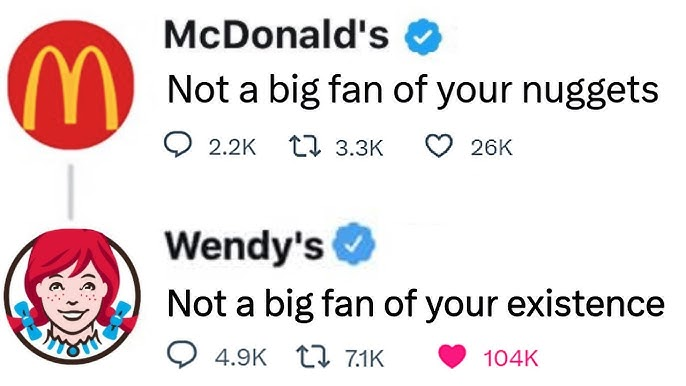
12. Wendy's: The Comeback Queen
Wendy's TOV is unapologetically sassy, competitor-roasting, and built entirely around social conversation. They turned fast food social media into a sport and they are currently winning it.
Their bio on X reads: "We like our tweets the way we like our fries: hot, crispy, and better than anyone expects from a fast food restaurant." That's a complete brand tone of voice statement in one sentence. Their social media team roasts competitors, responds to customers with sharp wit, and participates in internet culture in a way that feels genuinely native rather than brand-approved.
The copy across channels: on X they've built an entire identity around being the fast food brand that says what other fast food brands won't. Responses to McDonald's are legendary. Customer interactions are playful and specific rather than generic customer service scripts. Their app notifications use the same sassy register as their social media posts, which means the brand's voice doesn't feel like a marketing exercise. It feels like a personality. This is a great example of a company using TOV to carve out an entirely distinctive position in a highly saturated category.
Wendy's Chief Marketing Officer has described their social approach as creating a space where "people come to be entertained," and the tone is tactical rather than random, maintaining sharp wit without crossing into genuinely alienating territory. The brand looks confident in the social space, and that confidence is itself part of the brand's personality.
Why it worked
Wendy's made a strategic decision to sacrifice some neutrality in exchange for memorability. In a category where most brands sound identical, a brand voice with genuine personality and opinions becomes a competitive differentiator. The TOV is also completely honest about what the brand is. Wendy's isn't premium. It's not trying to be. The voice says that plainly and makes it a strength.
Your key takeaway
Having a clear brand opinion about your category is itself a TOV strategy. Find your take. Then say it.

13. Glossier: The Community Builder
Glossier's TOV is warm, conversational, inclusive, and built FROM the community rather than AT it. In a beauty industry full of brands telling women what they should look like, Glossier asked women what they actually did, and built the brand around the answer.
Glossier's brand voice was built on an insight from founder Emily Weiss: that all women have a beauty routine, but they just don't like to talk about it openly. Uncovering that truth, and creating a space to talk about it, made all the difference. Their tagline "Skin first. Makeup second. Smile always." is soft and welcoming. But what makes the brand's voice genuinely distinctive isn't the tagline. It's the fact that it sounds like it was written by the community, not for it.
The copy across channels: Glossier's tone feels like a trusted friend rather than a corporate voice, fostering the kind of emotional connection that today's audiences actively seek. Product names like "Milky Jelly" and "Boy Brow" carry the brand's personality through to the product itself. User-generated content isn't a content creation tactic. It's the core of the brand's communication strategy, which means the TOV is genuinely co-authored with the people it speaks to. The brand rewards that by replying to every mention and sharing customer content across all brand channels, from social media posts to product pages to newsletters. The positive change this creates in how the audience perceives the brand is not accidental. It's the result of a sustained, deliberate strategy built around community participation.
Why it worked
Glossier's TOV works because it genuinely listens before it speaks. When sourcing their best-selling moisturiser, Glossier wanted jars for packaging. Customer feedback suggested jars were viewed as less hygienic, so the brand went with a pump instead. That's a company treating community input as editorial input. The brand looks, sounds, and feels like it was built with its audience rather than for them. That's rare, and it's a powerful tool for building the kind of loyalty that purely brand-led communication can't replicate.
Your key takeaway
If your TOV is supposed to feel like community, your community needs to genuinely shape it. Listen first. Write second.
The TOV trend trap: why copying a brand voice you admire is a mistake
There is a version of this post that you might read and immediately think: we want to sound like Innocent. Or we want to sound like Oatly. We want that energy.
Don't.
Not because those brands aren't brilliant. They are. But because their voice is an expression of their specific brand belief, their specific audience, and their specific moment in time. Innocent's voice came from three people who genuinely believed that health food didn't have to be po-faced. Oatly's came from a Swedish oat milk brand that decided to behave more like a creative agency than an FMCG company. Pine-Sol's TikTok persona came from a willingness to be absurd that a different brand in a different sector might never get away with. Even charities — organisations that might seem to have the most freedom with TOV — need to start from a genuine understanding of their target audience's emotional state, not from the voice of another charity they admire.
Brand tone of voice goes through trends. There was an era when every brand wanted to sound like Innocent. What followed was a tsunami of wackaging and inappropriately glib copy. Right now, the trend is toward unhinged, absurdist content in the social space, because Duolingo and Ryanair and Wendy's made it work. Brands are queuing up to have their own "chaotic" social presence without stopping to ask whether that brand's tone has any connection to what they actually are.
An energy drink brand can sustain an expressive voice that a financial services company never could, not because one is more creative, but because the audience's expectations of that sector are completely different. "Considerate means" something very different to a banking customer than it does to a 19-year-old on TikTok watching an owl cry about missed language lessons.
The question to ask before you define your TOV is not "what brand do we want to sound like?" It's: who are we genuinely talking to, what do they expect from brands in our sector, and what space is no one else occupying? Build from there. Your brand's voice should feel like the most authentic possible expression of your brand.
What AI is doing to brand voice and what to do about it
AI AI AI… the conversation everyone is tired of.
AI tools are now part of most content teams' daily workflow, from blog posts to social media posts to email marketing. They're producing content at scale, which means they're also producing inconsistency at scale when the brand doesn't have clear enough guidelines to direct them.
The result is content that sounds vaguely like the brand, passably on-message, but subtly flatter and more generic than what a human who deeply understood the brand would write. Do that at volume and you erode the brand recognition and distinctiveness that the TOV was built to create.
So throw AI in the bin? No. Ai is not going anywhere and it is indeed a helpful tool for all marketers. But to make it work for you, you need clear guidelines that are specific enough, and practical enough, that you aren’t left with flat, same-same copy every time.
That means going beyond adjective lists and tone descriptors. It means real copy examples at every level: social media posts, email marketing, push notifications, packaging, error messages, customer service scripts. It means building an AI prompting guide into your TOV documentation alongside the guidelines themselves, so that when a team member asks an AI to write a caption, the output starts from a place already anchored in the brand.
Brands like Monzo built their guidelines around practical copy examples that make the right choice the easy choice. That's the same principle applied to AI: build your documentation so specifically that using it well becomes easier than using it badly.
The brands that win on TOV over the next five years will treat their guidelines as a living, working document updated in real time. The Starbucks brand voice guidelines and the Uber brand voice guidelines are both cited as examples of this kind of practical, specific documentation. Neither is just a list of adjectives. Both are working tools.
What all 13 of these brand tone of voice examples have in common
Look across these thirteen very different brands and a few consistent best practices emerge.
The voice is rooted in a genuine belief. Patagonia believes in buying less. Monzo believes banking should be simple and kind. Oatly believes oat milk advertising shouldn't look like oat milk advertising. Every TOV on this list is an expression of the company's core values or a core belief.
The guidelines are practical. Monzo's document includes real before-and-after copy examples. The Mailchimp content style guide specifies exactly how to handle humour when the reader might be stressed. The brands with the best TOVs have done the work of translating principles into actual guidance that a new team member could use on their first day. Concise brand guidelines that are genuinely usable beat comprehensive PDF documents that sit in a folder somewhere, unread.
The brand's voice adapts by channel without losing its character. Duolingo's TikTok sounds different from their onboarding flow. Ryanair's social team sounds different from their booking confirmation emails. Different elements of the same voice show up differently in different contexts. Consistency is important, but so is adaptation of tone. If you have the same tone on TikTok as you do in your customer service emails, one will suffer.
The voice is willing to exclude people. Every brand on this list has made a clear choice about who they're for. None of them are trying to speak to everyone. That's exactly why they speak so effectively to someone. A well-defined brand voice that excludes some people connects far more powerfully with the right ones.
The TOV is a powerful tool for commercial growth. Monzo's TOV changes drove a 500% increase in overdraft uptake. Oatly's brand voice took a niche Swedish oat milk brand to $643 million in revenue. Patagonia's "Don't Buy This Jacket" campaign grew sales by 30%. A consistent brand voice that connects builds trust, and trust builds businesses. TOV is an important part of brand identity and a direct commercial lever. Anyone who tells you otherwise is someone whose TOV document is living in a folder nobody opens.
How to develop your brand tone of voice
The starting point is two questions.
Will this TOV serve our wider strategy, or does it just sound nice?
How will it actually connect with the specific target audience we're talking to?
Those questions rule out a lot of beautiful-sounding TOV work that produces copy no one reads twice. They force the conversation away from "what do we want to sound like" and toward "what do we need to say, and who are we saying it to?"
From there, the work is practical. Write your tone guidelines with clear principles and with as many copy examples as you can. What does the brand look and sound like when it's explaining a price increase? When it's celebrating a customer win? When it's writing a push notification at 7am? When something has gone wrong? Build your guidelines document around those moments and then build an AI prompting guide alongside it, so that when your team uses AI tools, the output starts from a place already anchored in the brand.
Think of it less like a style guide and more like an onboarding document for every person who will ever write a word for your brand. Because that's what it is.
We've covered the full framework for how to build your brand voice, including the best practices for documenting, testing, and maintaining it as you grow, over here: https://www.iamfemale.co.uk/blog/brand-voice. The short version: a TOV that lives only in a document has already failed. A consistent brand voice that lives in every single word your brand writes is the most underrated commercial asset you have.
We build TOVs that actually live in the work
At I Am Female* we build verbal identity for challenger brands, FMCG brands, and brands targeting women, and the standard we hold ourselves to is the same one we've used to assess every brand in this post. Does the brand's voice show up in every channel? Is it rooted in a genuine belief? Does it connect with the specific audience, not the theoretical one? Is it practical enough for a whole content team to actually use, or is it going to end up as a set of brand looks that inspired nobody?
If your brand's TOV is living in a document rather than in the copy, or if you don't have one yet and you're relying on whoever's writing that week to figure it out, that's exactly the kind of problem we solve. Whether you're a founder looking for a starting point or a brand director whose team needs clear guidelines that actually get used, we'd love to talk.
Let’s chat and figure out what your brand actually sounds like.


Go on… steal all of our brilliant ideas


Go on… steal all of our brilliant ideas
Fancy some emails you’ll actually want to read? Sign up for our newsletter and we’ll slide into your inbox with insights on how you can make your brand hotter than Dante's inferno.