
.png)
Basic B*tch Thinking Is Killing Brands. Time to Think Queerer
A lot of marketing right now is boring. It follows the same patterns and rules that churn out lightly-salted content that people thumb past and forget. AI is being trained on the same content, and reproducing it on a mass scale, until everything looks the same and it’s all just fine.
Content that floats about the sea of bland starts with thinking differently. The world isn’t linear, and your audience isn’t either; culture doesn't move in one direction, and people are layered and contradictory. They don’t want to see straight, flat culture (because, some offense, it’s so dull), yet many brands are still thinking in binaries and forcing content from rigid systems into boxes that no longer exist.
Straight thinking is killing your brand. When basic comms are the norm, and everyone’s Instagram feed looks the same, everyone becomes invisible. The cure is to think queerer.
What is queer thinking?
Queer is increasingly interchanged with gay, to the point where many people hear “queer marketing” and assume gay men, but (unlike the patriarchal society we live in), we are not talking about men, or even specifically about queer people. Queer thinking is about changing your perspective by questioning everything you take as the norm.
Queer thinking has shaped the world we live in. The processors powering your phone run on architecture designed by Sophie Wilson and Lynn Conway, two pioneering transgender women, and the way we use the internet traces back to Alan Turing, a gay man. The slang in your group chat - being shady, clocking it, spilling the tea - comes from Black and Latinx LGBTQIA+ ballroom culture in Harlem, and even the British word "naff" comes from Polari, the coded language gay men used in the 1950s and 60s.
Queer people have never had the luxury of being average. When society isn’t built for you, you have to work harder to prove yourself; you adapt to be more resourceful and more creative. But don’t switch off if you think this isn’t for you; if you’re a brand wanting to be braver, it is. You don’t have to be queer to think queerer.

Okay, I’m in - how do I think queerer?
Being less average starts with self-awareness. It’s easier than ever to follow the crowd, to go along with the norms of how everything works without questioning if it should work that way. You need to start being curious, and challenging yourself and others.
We’ve put together a three-pillar framework that every brand can implement. Before you launch your next campaign, run it through these points.
Dismantle the norm
Queerness has always been about questioning default assumptions, so marketers should too; best practice is outdated and dull. We developed the IAF* F*ck-the-Default method; four steps to dismantle the norm.
- Awareness: Notice that gut feeling of "this is just how it's done".
- Acknowledge: Name the specific assumption. What "fact" is your brain treating as fixed?
- Ask: Challenge it. What evidence do you actually have, and where did this rule come from?
- Adjust: Swap the assumption for a question. "We always do X" becomes "what would happen if we didn't?"
This process flags if you’re following rules for the sake of it rather than it aligning with your brand values. Take LGBTQ marketing. If you’re running a Pride Month campaign every June then ignoring queer people the rest of the year, you’re pinkwashing. Performative allyship without support for real LGBTQIA+ rights is harmful, even if it’s not intentional. We know it can be difficult to know where to start, so we wrote a piece on How to build a Pride campaign that actually lands, that might help you.
Dismantling the norm also leads to challenger brand thinking, and if you want more advice on that, check out our article on Challenger brand marketing strategy.
Embrace nuance
Queerness rejects binaries, as does queer thinking. Straight thinking erases whole identities and alienates your audience; people are not a demographic to fit into neat boxes. Humans are nuanced and messy and you need to be the same to be able to authentically connect with them.
Check off these three steps to think a little more nuanced.
- Pause before forming an opinion
The instinct to immediately react or resolve is often what kills nuance. Sit with the discomfort a little longer and see what comes up. - Look at multiple truths
Two opposing things can both be true at the same time. - When you see A or B, look for C
Is there a C? Has anyone found it yet? Are we assuming it doesn’t exist?
Radical authenticity
Queer identity has always meant rejecting expectations and being who you are. For brands, being radically authentic takes guts, especially if there’s backlash (but if it was easy everyone would be doing it). Embrace the challenge - let’s f*king go.
These four points will help you find what you stand for, and stick to it always.
- Find your specific point of view
What does your brand actually believe in? The things you’d say if you weren’t afraid. - Let some people not like it
A brand with a real point of view will lose some people, and that’s a good thing; you don’t want to be liked by every tepid Tom. The ones who stay will be obsessed, and that’s the kind of audience you want. - Own your mistakes
Radical authenticity looks rough sometimes. Not all opinions and choices will be right; if you get something wrong, own it and learn from it. - Audit the gap
What your brand says it believes, versus what it actually does. If there’s a gap between them, your audience has noticed. Brand authenticity and values are only worth something if they’re reflected in everything the brand does. If you want more tips on this, check out our guide to Authentic branding in 2026.
Queer thinking in action
To everyone dating in 2026, we salute you in the trenches. The burnout is real - 78% of all users have reported it, and the UK’s top dating apps lost nearly 16% of their users in a year, with millions of people leaving Tinder, Bumble and Hinge.
We worked with a dating app that recognised this fatigue, and wanted to do something different. HER, the sapphic dating app, came to us because their marketing was thinking straight and wasn't landing. They wanted to reach a Gen Z sapphic audience, where authenticity is critical. We turned the “everything reminds me of her” trend into an explicitly sapphic OOH campaign, “The Sapphic Restart”, by working with a team of all queer women to build the entire thing. Strategy, copywriting, photography, and design; all created by sapphics for sapphics.
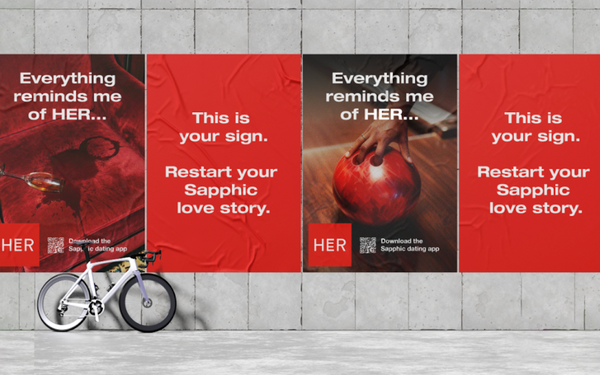
It was authentic, specific, and spoke to their target audience without worrying if everyone else would be confused, and it worked. People snapped pics and videos in the street; organic campaign content went viral on TikTok with almost a million views and over 100,000 likes. The campaign was covered by multiple queer news channels, including Pink News, Girl Talk HQ, and Queer News Tonight, and it’s been shortlisted for the best OOH Campaign at the Creativepool Awards. HER loved it so much, we’re now their long-term sapphic partners. Their go-to for everything sapphic in brand strategy, tone of voice, social media, and additional campaigns like “Sapphics date better” and “Date a sapphic hotline”.
Queer thinking creates actual authenticity, and if you want to connect with a community, you need to start co-creating with the people in it (any paying them!)
You don't have to be queer to think queerer
Okay, so the above example is very queer, but queer thinking is for everyone who wants their marketing to be less boring. Queer thinking gets you more creative ideas, more diverse perspectives, and opinions that start conversations; these are things that every brand could benefit from.
We built I Am Female* on the belief that diverse minds build better ideas, which is why we work with women (if you identify as a woman, you are a woman), LGBTQIA+ and under-represented talent, and it's why we want to help you think queerer, regardless of your identity or orientation. If this article made you side-eye your current marketing, give us a shout. Let’s make your brand less basic and a hell of a lot queerer.


Go on… steal all of our brilliant ideas


Go on… steal all of our brilliant ideas
Fancy some emails you’ll actually want to read? Sign up for our newsletter and we’ll slide into your inbox with insights on how you can make your brand hotter than Dante's inferno.